
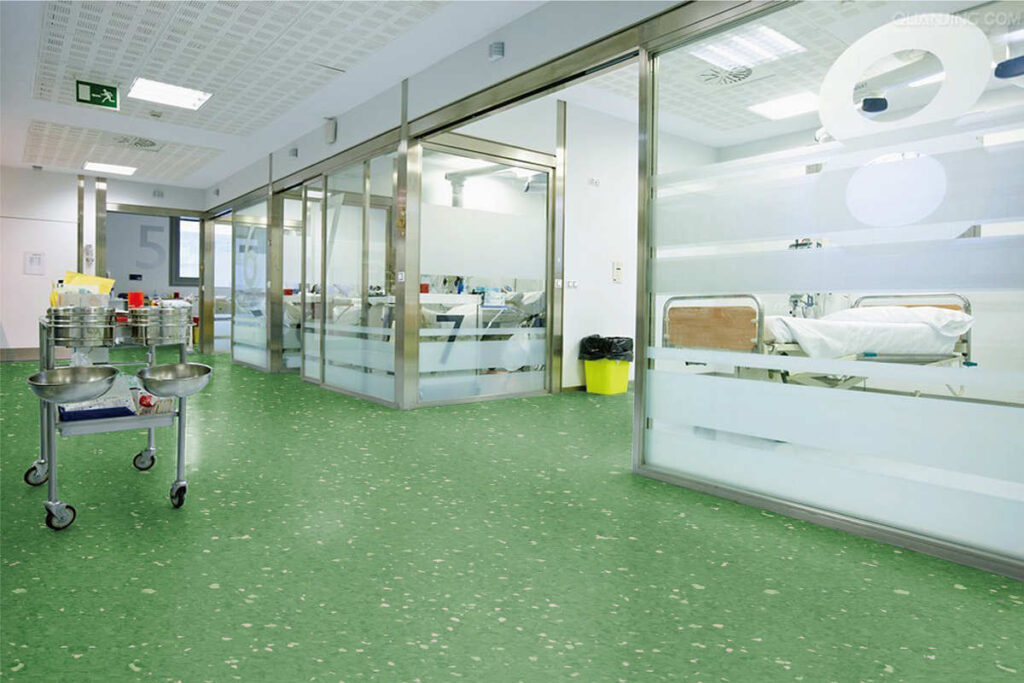
When selecting homogeneous vinyl flooring for high-traffic commercial projects such as hospitals, classrooms, and stores, understanding its abrasion resistance rating is crucial. The two most common classifications in European standards (EN 660-2 and EN ISO 10581) are Grade T and Grade P.
Both grades are suitable for heavy-duty commercial flooring, but Grade T represents the highest abrasion resistance for extremely high-traffic areas, while Grade P offers a highly durable and cost-effective option for standard commercial spaces
1. Testing Methodology and Quantitative Performance Metrics (EN 660-2)
In the technical specification of resilient flooring, homogeneous vinyl sheet represents a distinct category defined by a single, uniform layer of material throughout its full thickness. Homogeneous vinyl relies entirely on its core bulk formulation for long-term wear performance.
To objectively evaluate and quantify wear resistance, European standardization bodies established explicit testing metrics under EN 660-2 (the Frick-Taber abrasion resistance test).
The Frick-Taber Test Protocol
Under the EN 660-2 testing standard, a circular sample of homogeneous vinyl is subjected to continuous mechanical wear using pair-mounted abrasive wheels loaded with a specific weight. The test runs for 5,000 continuous revolutions. During this process, abrasive grit causes surface friction, grinding away micro-particles of the flooring formulation.
Rather than measuring wear by weight loss—which can be misleading due to variations in material density—the standard measures absolute volumetric loss expressed in cubic millimeters(mm³).
Detailed Classification Rules
Group T (Volume Loss ≤ 2.0 mm³): Group T represents the ultra-low wear level under European testing standards. After 5000 cycles under the grinding wheel, the total wear of the material does not exceed 2.0 mm³. This low volume loss indicates excellent surface texture density and resistance to frictional damage.
Group P (Volume Loss > 2.0 mm³ to ≤ 4.0 mm³): Group P represents the heavy commercial wear level. Under identical testing conditions and grinding wheel speeds, the volume loss of the material is between 2.0 mm³ and 4.0 mm³. Although its material loss rate is higher than Group T under the same frictional stress, it still fully meets the performance requirements of high-flow commercial environments.
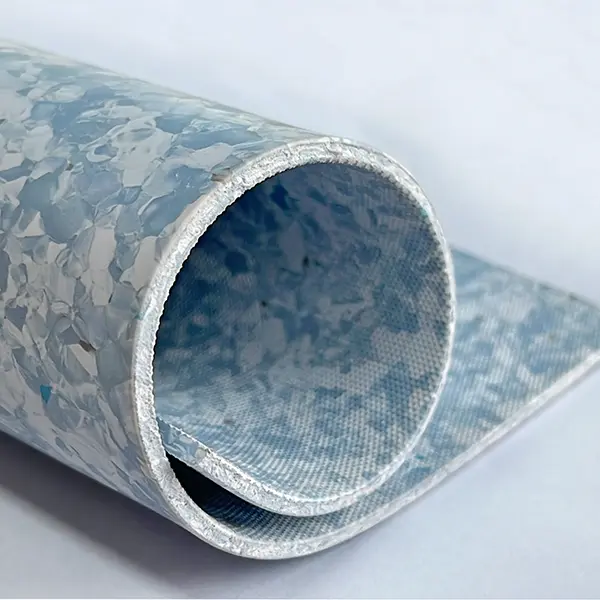
2. Chemical Composition and Material Science (EN ISO 10581)
Because homogeneous PVC is a single solid compound from top to bottom, its abrasion resistance depends directly on its chemical formulation—the ratio between unfilled PVC resin binder and mineral filler (primarily calcium carbonate).
The EN ISO 10581 standard classifies homogeneous PVC formulations according to the content of pure PVC binder, corresponding to abrasion resistance grades: Group T corresponds directly to Type I, and Group P corresponds directly to Type II.
Formulation Overview
Group T (Type I): Formulated with a pure PVC resin binder content ≥55%. High concentrations of long-chain polymer molecules form a dense, highly cohesive molecular matrix. The remaining portion consists of plasticizers, stabilizers, pigments, and a small amount of mineral fillers.
Group P (Type II): Formulated with a pure PVC resin binder content between 35% and <55%. To refine the formulation, a higher proportion of mineral filler (calcium carbonate) is added to the matrix.
Weight intuitively distinguishes Group T from Group P
When selecting products, in addition to standardized wear resistance tests, total weight (g/m²) offers a more intuitive reference for identifying the structural characteristics of homogeneous vinyl sheet.
As homogeneous sheet features a single-layer structure, its weight is directly determined by factors such as PVC resin content, the proportion of mineral fillers, material density, and the overall formulation design.
Group T / Class T
Reference weight: 2800–2900 g/m²
Compared to Group P, this type is lighter, primarily due to higher PVC resin content and specific polymer structural characteristics.
Characteristics: Greater molecular flexibility, superior elastic recovery, and better performance under dynamic loads.
Group P / Class P
Reference weight: 3000–3100 g/m²
Heavier, primarily due to an increased mineral filler content in the formulation.
Characteristics: Higher density, greater rigidity, and superior resistance to static loads.
Due to variables such as raw material batches, production processes, and measurement conditions, the flooring industry typically allows for a certain tolerance range regarding total weight. While weight figures serve as a practical reference for evaluating material structure and performance, the official wear resistance classification is determined based on standardized EN 660-2 test results.
Influence of Composition on Physical Properties
- Tensile Strength and Elasticity: Group T (Type I) has a higher resin concentration, resulting in higher tensile strength, flexibility, and elongation. Group P (Type II) has a higher filler content, resulting in higher physical stiffness and lower elasticity.
- Dynamic Load and Indentation Recovery: Under heavy dynamic loads (e.g., mobile hospital beds, heavy equipment trolleys, or heavy wheeled traffic), the elastic polymer network of Group T undergoes slight deformation under pressure and returns to its original shape after load transfer. Group P provides a stronger, more rigid substrate and withstands static loads excellently, but exhibits poor elastic recovery under extreme localized point pressures.
- Heat Welding Performance: The installation of homogeneous sheet vinyl typically requires heat welding using PVC welding rods to create seamless, hygienic seams. Due to the higher concentration of pure PVC adhesive in Group T (Type I), its heat welds achieve greater molecular fusion, resulting in superior tensile strength.
3. Group T vs. Group P Technical Specs & Application Matrix
| Performance Metric / Zone | Group T Homogeneous Vinyl | Group P Homogeneous Vinyl |
| EN 660-2 Abrasion Loss | ≤ 2.0 mm³ (Ultra-Low Loss) | 2.0 to 4.0 mm3 (Low Loss) |
| Binder Content (EN ISO 10581) | Type I (≥ 55% PVC Binder) | Type II (35% to < 55% PVC Binder) |
| Healthcare Facilities | Emergency rooms, main corridors, operating theaters, ICU units | Patient rooms, administrative offices, consultation rooms |
| Educational Facilities | Main entrance foyers, high-traffic assembly halls | Standard classrooms, libraries, faculty offices |
| Commercial & Public Buildings | Airports, train terminals, supermarket main aisles | Corporate offices, boutique retail, conference rooms |
| Mechanical Characteristics | Superior indentation recovery & chemical stain resistance | High dimensional stability & solid static load resistance |

4. Technical Misconceptions Clarified
Misconception 1: “Group P (Type II) is an inferior or non-commercial material.”
Clarification: Group P (Type II) has passed European performance rating certification and is fully suitable for heavy-duty commercial applications. Its performance is significantly superior to standard residential or light-duty commercial flooring materials. Under extreme laboratory abrasion conditions, its volumetric abrasion loss (2.0 to 4.0 cubic millimeters) is only slightly higher than Group T, making it a unique and high-performance category within heavy-duty commercial materials.
Misconception 2: “The total thickness of the product determines the abrasion resistance rating or adhesive type.”
Clarification: In reality, Group T and Group P ratings are determined by abrasion performance measured according to EN 660-2, specifically the volume loss during testing.
The product thickness is only a dimensional specification and does not change the inherent abrasion group. Similarly, PVC binder content (Type I or Type II classification under EN ISO 10581) influences formulation performance, but it is not identical to the Group T or Group P abrasion classification.
5. Conclusion
Group T and Group P homogeneous vinyl sheets offer different levels of wear resistance for various applications. Group T is ideal for high-traffic environments requiring maximum durability, while Group P provides a cost-effective solution with reliable performance for general commercial areas.
By understanding the differences between these two classifications, you can select the right flooring solution based on performance requirements, application needs, and budget considerations.