
Introduction
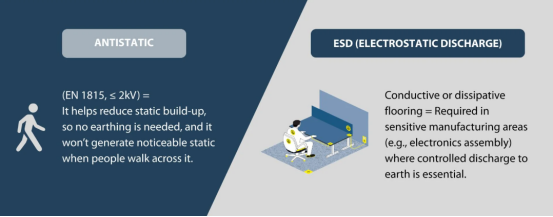
Anti-static flooring and ESD flooring are frequently confused, yet they deliver vastly different electrostatic protection levels. Selecting the wrong type will either waste costs or fail to safeguard sensitive electronic devices. Per ANSI/ESD S20.20, IEC 61340 and ASTM F150, the two categories have distinct electrical standards and applicable scenarios.
What Is Anti-Static Flooring?
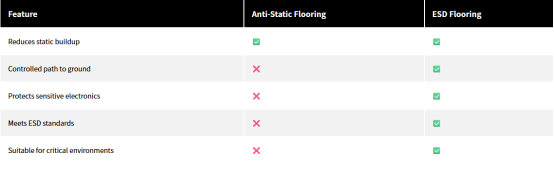
Anti-static flooring minimizes static charge buildup generated by walking, cart movement and equipment friction. Its core function is to limit static generation, rather than form a stable conductive channel to ground.
Limitations
It cannot drain static charges continuously, so it cannot fully protect delicate electronics from ESD damage. Typical resistance range: 10⁹–10¹¹ Ω, suitable for low-static-risk spaces.
What Is ESD Flooring
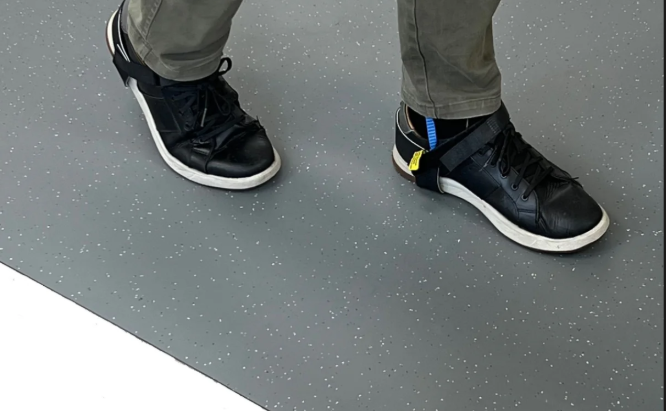
ESD (Electrostatic Discharge) flooring creates a reliable conductive path to safely release static to the building earth, which is mandatory for static-sensitive manufacturing areas.
Core Advantages
- Continuous controlled grounding route
- Comprehensive protection for fragile electronic components
- Permanent stable surface & volume resistance

Key questions to ask before choosing flooring
Q1: Does this area produce static or hold static-sensitive items?
- No/low risk: Ordinary anti-static flooring works; Y.H.F regular series fits.
Q2: Does the room process circuit boards, electronics or static-sensitive devices?
- Yes: Need full grounded ESD system (EC conductive / SD dissipative), check Q3.
Q3: What resistance value does your device supplier require?
- Below 10⁶ Ω: Pick EC conductive flooring
- 10⁶ ~ 10⁹ Ω: Pick SD static-dissipative flooring
When uncertain, consult the electrical engineer first.