
Introduction
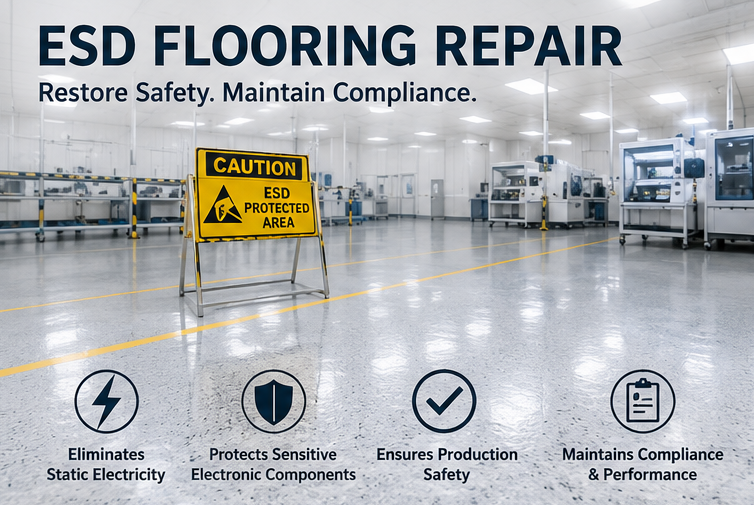
ESD flooring is a critical safety infrastructure for electronic manufacturing workshops, cleanrooms, data centers, and precision instrument laboratories. It effectively eliminates static electricity accumulation, protects sensitive electronic components from static damage, and ensures production safety and operational compliance. However, long-term foot traffic, equipment rolling, accidental impact, chemical corrosion, and aging degradation will inevitably cause different degrees of damage to ESD flooring. Minor damage may affect surface aesthetics and cleaning performance, while severe damage will destroy the conductive continuity of the floor, lead to failure of static dissipation function, bringing huge hidden dangers to production and equipment safety.
Timely and standardized repair of damaged ESD flooring is the key to restoring static control performance, extending floor service life, and avoiding costly overall replacement. This article sorts out classified damage judgment, targeted repair processes, compliance testing, and daily maintenance precautions to provide professional, operable repair solutions for different types of ESD floor damage.
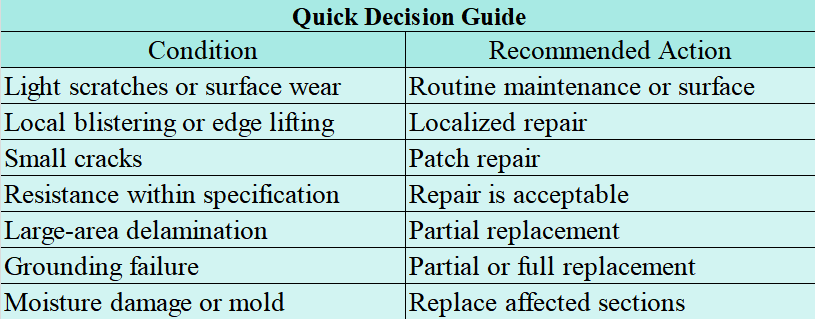
Not all damaged ESD flooring needs to be replaced. Minor surface wear and localized damage can often be repaired while maintaining compliant electrical performance. However, widespread structural damage, substrate failure, or loss of grounding continuity usually requires partial or full replacement. The appropriate repair method depends on both the physical condition and the electrical performance of the flooring system.
Can Damaged ESD Flooring Be Repaired or Should It Be Replaced?
Yes—but not all damage requires replacement.
Minor scratches, localized wear, edge lifting, and small cracks can often be repaired while maintaining compliant ESD performance. However, widespread structural damage, substrate deterioration, or loss of grounding continuity generally requires partial or complete replacement.
The decision should always be based on both the floor’s physical condition and its electrical performance. After any repair, electrical verification should be performed according to ANSI/ESD STM7.1, while the flooring system should continue to comply with ANSI/ESD S20.20 or IEC 61340-5-1.
Types of ESD Flooring Damage
Before selecting a repair method, inspect both the visible damage and the floor’s electrical performance.
1. Minor Surface Damage
Typical signs include:
- Fine scratches
- Surface scuffs
- Gloss reduction
- Minor wear
The conductive structure remains intact, and resistance values usually remain within specification.
Recommended action: Routine maintenance or surface repair.
2. Moderate Localized Damage
Typical signs include:
- Local blistering
- Edge lifting
- Small cracks
- Partial separation
- Local grounding issues
These defects may interrupt conductive continuity and should be repaired before they spread.
Recommended action: Localized repair followed by resistance testing.
3. Severe Structural Damage
Typical signs include:
- Large-area delamination
- Substrate deterioration
- Moisture damage
- Broken supports
- Grounding failure
Structural damage usually affects both mechanical stability and electrical performance.
Recommended action: Partial or complete replacement.
Repair Methods
1. Repairing Minor Surface Wear & Scratches
Suitable for
- Surface scratches
- Scuffs
- Light abrasion
- Gloss loss
Repair Steps
- Clean the damaged area with an approved neutral ESD cleaner.
- Lightly polish the surface if recommended by the manufacturer.
- Where approved, apply a compatible ESD conductive finish or maintenance coating. Many modern homogeneous conductive flooring products maintain permanent conductivity and do not require additional coatings.
- Allow the repair to cure fully.
- Verify electrical resistance after curing.
2. Repairing Localized Blistering, Edge Lifting & Small Cracks
Suitable for
- Local blistering
- Edge lifting
- Small cracks
- Limited adhesive failure
Repair Steps
- Remove the damaged flooring with clean, straight cuts.
- Clean and inspect the substrate for moisture or damage.
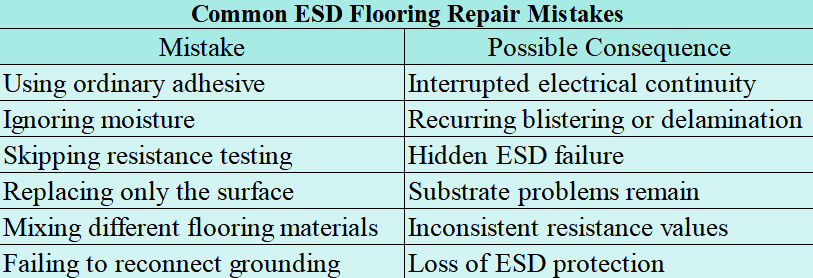
- Install a matching replacement section using approved conductive adhesive.
- Seal joints where required.
- Verify floor flatness and electrical continuity according to ANSI/ESD STM7.1.
3. Repairing Severe Structural Damage
Suitable for
- Large-area delamination
- Substrate failure
- Extensive moisture damage
- Complete grounding failure
Repair Steps
- Remove damaged flooring and compromised substrate.
- Repair and level the subfloor.
- Install matching ESD flooring using approved materials.
- Restore the grounding system.
- Perform comprehensive compliance testing, including surface resistance, resistance-to-ground, and grounding continuity.
Compliance Testing After Repair
Physical repair alone does not guarantee proper ESD performance. Every repaired area should be electrically tested after curing.
Post-repair verification should follow ANSI/ESD STM7.1, while the complete flooring system should continue to comply with ANSI/ESD S20.20 or IEC 61340-5-1.
Recommended Inspection Checklist
- Surface resistance testing
- Resistance-to-ground testing
- Ground continuity verification
- Visual inspection
- Floor flatness inspection
- Maintenance documentation
Best Practice: Always use manufacturer-approved repair materials and verify electrical performance before returning the floor to service.
FAQ
1.Can scratched ESD flooring still work?
Yes. Light scratches usually do not affect permanent conductive flooring, provided resistance values remain within specification.
2.Can ordinary vinyl flooring be used for repairs?
No. Replacement materials must match the original flooring’s conductive properties.
3.Should repaired ESD flooring always be tested?
Yes. Electrical testing is essential to verify compliance after every repair.
4.When should ESD flooring be replaced instead of repaired?
Replacement is recommended for extensive structural damage, severe moisture intrusion, grounding failure, or when localized repairs cannot restore compliant resistance values.
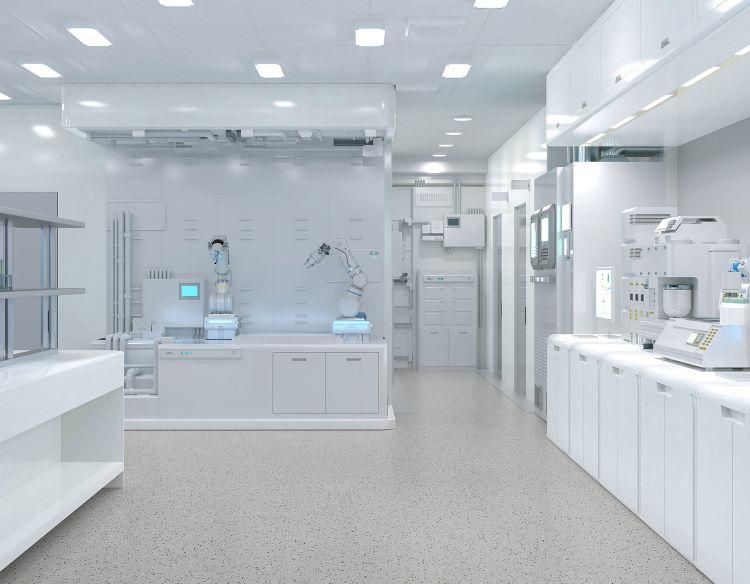
Conclusion
ESD flooring is the core guarantee of static safety in precision production and intelligent operation scenarios. Damaged ESD flooring is not only an aesthetic problem, but a major hidden danger to industrial safety and compliance production. For different degrees of floor damage, adopting classified repair, standardized construction and strict compliance testing can efficiently restore the anti-static function of the floor, maximize the service life of ESD flooring, and avoid the safety risks and economic losses caused by unqualified static control.
Adhering to the combination of timely repair and daily standardized maintenance is the key to maintaining the long-term stable performance of ESD flooring and ensuring the safe and compliant operation of cleanrooms, electronic workshops and data centers.