
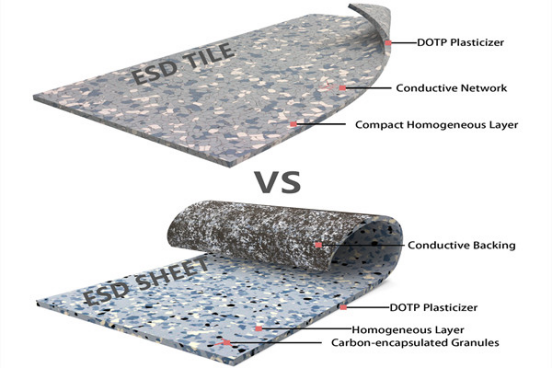
In high-tech manufacturing, medical environments, and electronics assembly lines, electrostatic discharge (ESD) is a silent, invisible hazard. A single static spark can destroy sensitive microchips, disrupt calibrated laboratory equipment, or create safety risks in volatile environments. To control this risk, choosing the right ESD flooring is essential.
When engineering and procurement teams look for an electrostatic control floor, they frequently face a foundational dilemma: Should we choose ESD Vinyl Tiles (pieces) or ESD Vinyl Sheets (rolls)?
Both ESD vinyl tiles and ESD vinyl sheets can provide effective electrostatic control when installed as part of a properly grounded ESD flooring system. However, they differ significantly in installation method, maintenance strategy, hygiene performance, and suitability for different commercial environments. Understanding these differences helps engineers, architects, and facility managers select the right solution for long-term performance—not simply the lowest initial cost.
| Quick Verdict for Buyers: Neither format is universally superior. ESD Vinyl Sheets are optimal for sterile cleanrooms requiring seamless, zero-cavity surfaces to eliminate bacterial and dust contamination. Conversely, ESD Vinyl Tiles excel in commercial environments utilizing raised access floors, complex layouts, and operations where quick, localized repairability is crucial. |
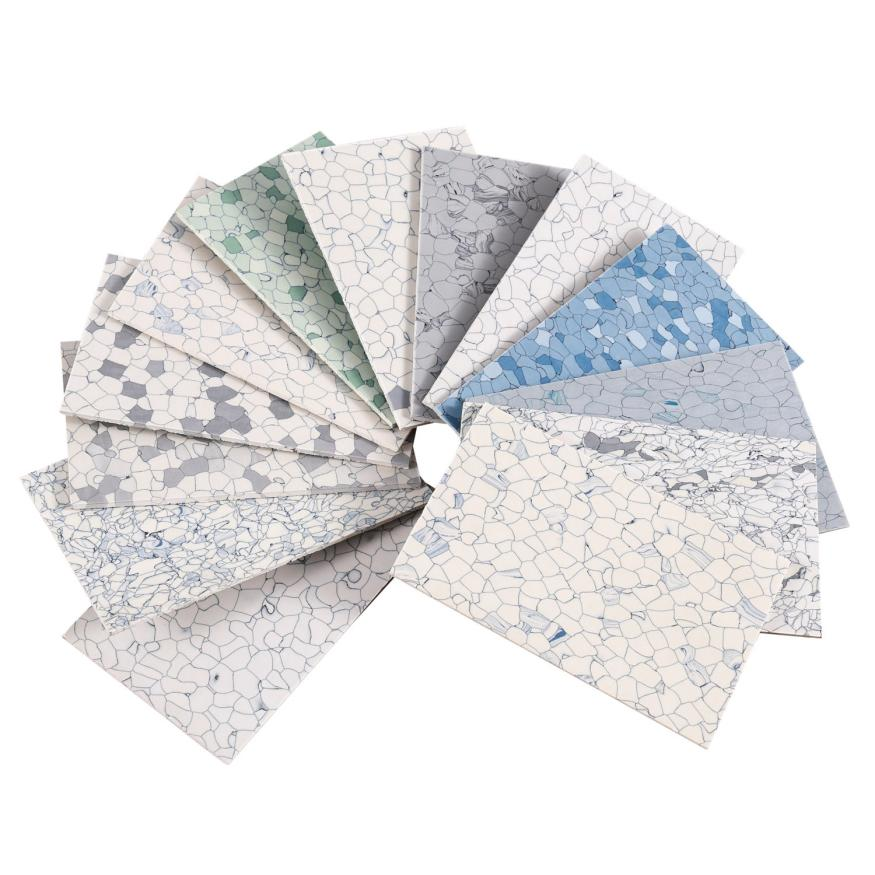
YHF ESD Tiles
Comprehensive Specification Comparison
Understanding the core operational differences between these two configurations ensures your flooring system meets both electrical resistance criteria and structural longevity goals.
| Feature Dimension | ESD Vinyl Tiles (Pieces) | ESD Vinyl Sheets (Rolls) |
| Dimensions & Format | Supplied as modular blocks (commonly 600x600mm, 610x610mm or 900x900mm with thickness of 2.0/2.5/3.0mm). | Supplied as continuous long rolls (typically 2m width × 20m or 15m length with thickness of 2.0/3.0mm). |
| Seam Configuration | Frequent grid-like joints. Requires hot welding along all seams (or can be tight-fitted for non-sterile areas). | Minimal seams. Parallel rolls are permanently joined via professional heat-welding. |
| Cleanroom & Hygiene | Very Good. Full-grid welding seals joints, though requiring more welding labor than rolls. | Optimal. Provides a monolithic, seamless surface that prevents dust and microbe traps. |
| Maintenance & Repair | Outstanding. Damaged sections can be fixed by replacing a single tile locally. | Complex. Requires localized patchwork or replacing an entire roll segment. |
| Access Floor Integration | Perfect. Integrates seamlessly with raised access floor panels for underground cabling. | Not recommended for access floor systems; blocks subfloor panel accessibility. |
| Material Waste Rate (Flooring) | Lower waste (approx. 2%-4%) in complex layout configurations. | Higher waste (approx. 7%-10%) due to cutting wide rolls to fit tight or irregular rooms.. |
| Welding Rod Consumption (Accessory) | Extremely high (if welded). Approx. 3.3m of rod per 1m^2 for full-grid welding (Zero if tight-fitted). | Standard / Low. Approx. 0.5m of rod per 1m^2 for parallel seams. |

YHF ESD Sheets
Deep Dive: The Strategic Advantages of ESD Tiles
1. Superior Localized Repairability
In active electronics assembly lines or high-traffic facilities, flooring surfaces endure continuous mechanical stress—ranging from dropped heavy tools to equipment movement. If a localized section is deeply gouged or damaged, its conductive network may be compromised. With modular ESD Tiles, maintenance teams can heat up the adhesive of the single affected tile, lift it, and bond a replacement tile. This localized repair capability minimizes facility downtime to minutes without disturbing surrounding areas.
2. Good Integration with Raised Access Flooring
Modern data centers, control rooms, and advanced semiconductor fabrication facilities utilize raised floor systems to route extensive cabling, piping, and HVAC ducting beneath the subfloor. ESD tiles can be pre-bonded or field-applied directly onto separate steel or calcium sulfate access panels (typically 600x600mm). This structural alignment allows facility technicians to remove individual panels at any time for subfloor maintenance without tearing or damaging the surface flooring. To ensure full static control across modular structures, the complete access flooring system should be installed and verified in accordance with ANSI/ESD S20.20 and IEC 61340-5-1 standards.
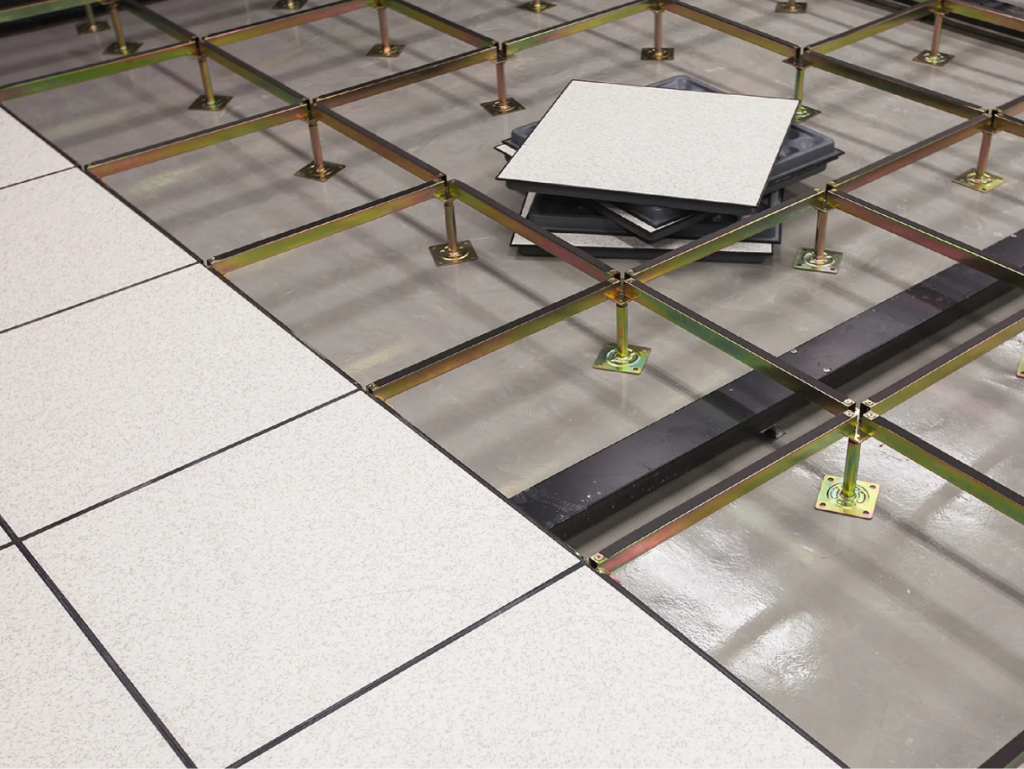
ESD Tiles on Raised Floor Pedestals
3. Dimensional Stability under Heavy Static Equipment
Rigid ESD vinyl tiles exhibit excellent dimensional stability and indentation resistance under heavy stationary machinery, test equipment, and automated production units. Their solid homogeneous construction distributes static loads evenly, preventing surface distortion or adhesive shear. (Note: For heavy rolling traffic such as high-tonnage forklifts, structural subfloor reinforcement and specialized hard-set adhesives must be evaluated regardless of tile or sheet formats.)
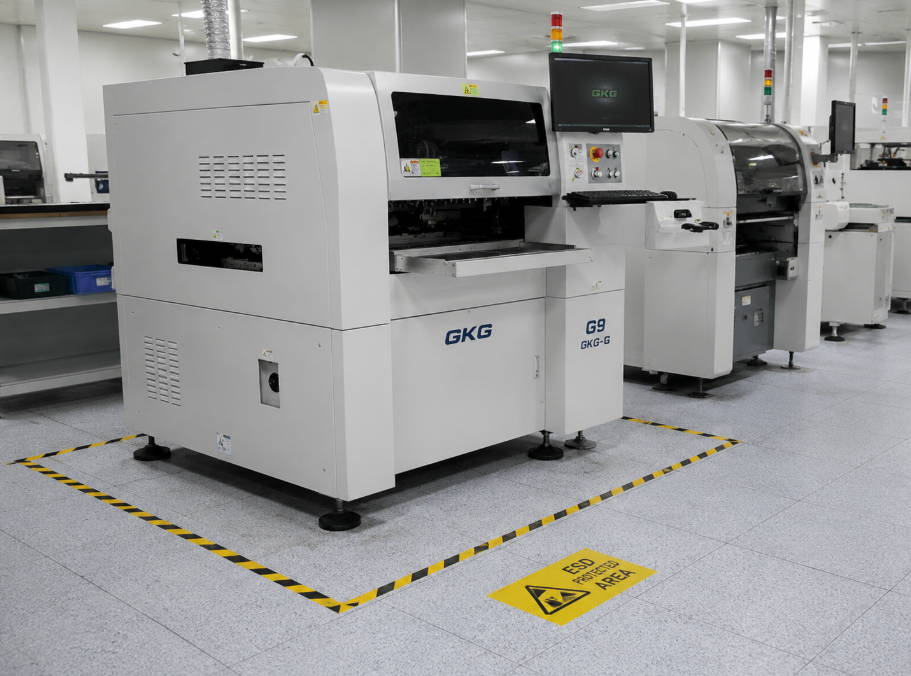
ESD Tiles Support Heavy Industrial Equipment
Deep Dive: The Strategic Advantages of ESD Sheets
1. Seamless, Monolithic Hygiene Control
In high-tier cleanrooms designed in accordance with ISO 14644 standards (such as pharmaceutical compounding, sterile medical device assembly, or semiconductor wafer processing), airborne micro-particles and biological contamination represent severe process risks. ESD sheets are laid down in continuous 2-meter-wide spans and heat-welded at parallel seams using matching vinyl welding rods. This creates a completely monolithic, smooth surface without crevices, minimizing particle accumulation points and simplifying stringent chemical sanitization routines.
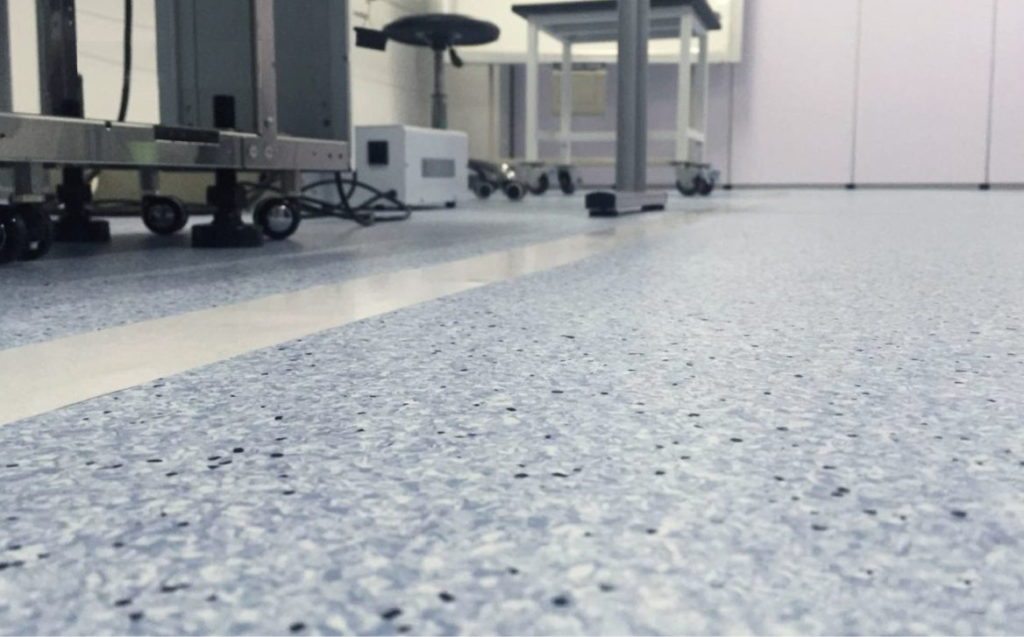
Heat-welded ESD sheet roll installation in a cleanroom lab
2. Faster Installation for Large Open Areas
For large open production halls, long corridors, or broad cleanroom floors, installing wide ESD sheet rolls is significantly faster than positioning hundreds of modular tiles. The reduced number of seams shortens total heat-welding installation hours, allowing faster operational commissioning and lower overall installation labor expenditure.
3. Streamlined Daily Maintenance
With fewer seam lines across open floor areas, automated floor scrubbing machines and maintenance personnel can perform routine cleaning faster. The continuous surface texture facilitates smooth equipment movement and maintains a uniform visual aesthetic across expansive facilities.
Electrical Properties and International Standards Compliance
Regardless of whether you select tiles or sheets, high-quality resilient ESD flooring must maintain uniform conductive pathways throughout its operational lifespan. Modern conductive vinyl utilizes a network of carbon-encapsulated granules or carbon-black veins integrated directly into the homogeneous layer to safely dissipate electrostatic charges to ground.
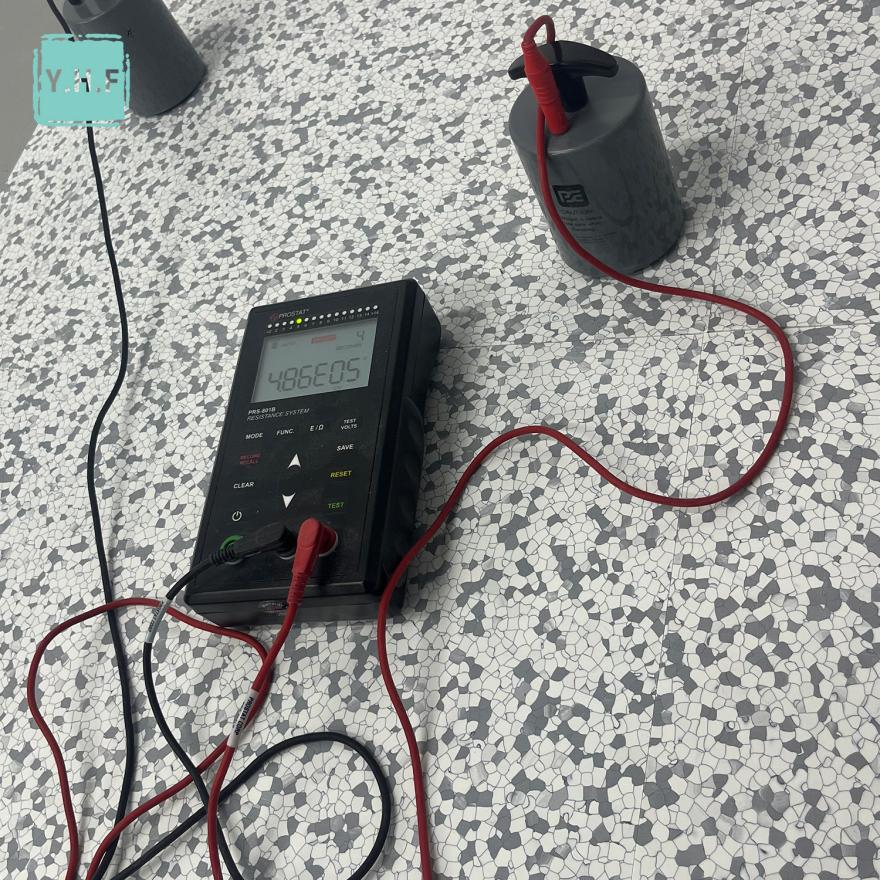
A surface-to-ground resistance test on ESD vinyl flooring with high-quality carbon black veins
Typical technical parameters comply with global industry benchmarks:
- Conductive Range: Surface and ground resistance of 1.0×10^4 to 1.0×10^6 Ω.
- Dissipative Range: Surface and ground resistance of 1.0×10^6 to 1.0×10^9 Ω.
Verification & Testing Methods
Electrical performance and system grounding should be verified using standardized industry test protocols:
· ANSI/ESD STM7.1: Floor Materials – Characterization of Electrical Resistance.
· ANSI/ESD S20.20 & IEC 61340-5-1: General requirements for electrostatic discharge control programs.
· ASTM F150: Standard Test Method for Electrical Resistance of Conductive and Resilient Flooring.
· Technical Tip: When specifying resistance parameters, ensure that product batch test reports match your facility’s exact ESD protection zone (EPA) requirements. Conductive tiles are often preferred in environments requiring higher carbon density, whereas sheets are frequently engineered within the dissipative range(10^6 –10^9 Ω)for general static control.
How to Choose: Decision Tree for Specifiers
Use this deployment matrix to select the appropriate flooring configuration based on your facility’s operational requirements:
| Operational Requirement | Recommended Solution | Key Selection Rationale |
| ISO 14644 Cleanroom Facilities | ESD Sheet | Minimizes seams to prevent particle accumulation and microbial contamination. |
| Raised Access Floor Integration | ESD Tile | Matches standard panel dimensions (600x600mm) without blocking subfloor access. |
| High Risk of Localized Physical Damage | ESD Tile | Allows individual damaged tiles to be replaced quickly without tearing large sections. |
| Large Open Production Halls | ESD Sheet | Faster roll installation reduces seam welding labor and accelerates timeline. |
| Frequent Room/Equipment Layout Changes | ESD Tile | Offers flexibility to reconfigure grounded floor zones or access panels as needed. |
| Strict Minimal Seam / Smooth Aesthetic Brief | ESD Sheet | Provides a seamless, continuous appearance ideal for laboratory environments. |