
The Invisible Shield: Choosing the Right Wear Layer for Residential and Commercial Flooring
In the world of resilient flooring—particularly SPC and LVT—the core determines stability, but the wear layer dictates longevity. It is the invisible shield that stands between a beautifully designed floor and the relentless friction of daily life.
For architects, designers, and distributors, choosing the correct wear layer is not just a technical detail; it is a critical decision that balances project budgets with long-term performance and ROI. Over-specify, and you inflate costs unnecessarily. Under-specify, and you risk premature failure and client dissatisfaction.
So, how do you find the perfect balance? Here is a definitive guide to selecting wear layers for both residential and commercial environments.

The Anatomy of Durability
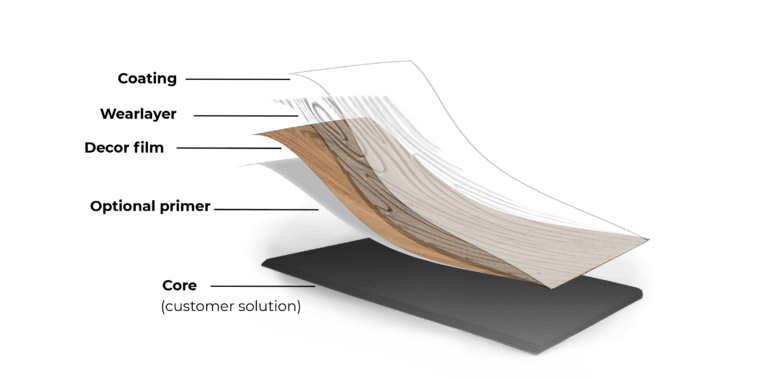
Before categorizing by application, it is essential to understand what the wear layer actually does. Situated just above the high-definition decor film and below the final UV coating, the wear layer is a clear, protective urethane film.
From a material science perspective, a premium wear layer is composed of 100% virgin Polyvinyl Chloride (PVC) combined with advanced non-phthalate plasticizers. This specific formulation ensures absolute optical clarity—so the high-definition design underneath is never distorted—while providing maximum tensile strength and flexibility.
| A common industry misconception: Actually, a thicker wear layer does not make the floor “harder” or more resistant to heavy impact dents (that is the job of the rigid core). Instead, it determines how many years of abrasive friction—footsteps, sliding chairs, and cleaning equipment—the floor can endure before the printed design is compromised. |
Residential Applications: The Balance of Comfort and Cost
In residential settings, the primary threats to flooring are daily foot traffic, pets’ activities, and accidental spills. The goal here is to provide sufficient protection without pushing the material cost into commercial territory.
- 0.2mm (8 mil) – Light Residential: Ideal for low-traffic areas such as guest bedrooms, upper-level home offices, or budget-conscious multi-family rental units. It offers basic protection where heavy wear is not a concern.
- 0.3mm (12 mil) – The Residential Standard: This is the “sweet spot” for most homes. It provides excellent resistance against scratches and stains in active family spaces, including living rooms, kitchens, and hallways. It balances durability with cost-effectiveness perfectly.
- 0.5mm (20 mil) – Premium Residential: For homes with large, active pets, or for entryways that connect directly to harsh outdoor environments, a 0.5mm wear layer offers the ultimate peace of mind.
Commercial Applications: Engineered for the Demands of Business
Commercial environments are unforgiving. Flooring in these spaces must withstand constant, heavy foot traffic, rolling loads, and rigorous commercial cleaning schedules while maintaining its visual integrity year after year.
- 0.55mm (22 mil) – Standard Commercial: This is the baseline for commercial specifications. It is engineered for environments like boutique retail stores, corporate office spaces, hotel rooms, and multi-family common areas.
- 0.7mm (28 mil) and Above – Heavy Commercial: When failure is not an option, you specify 0.7mm. This thickness is strictly designed for high-stress environments: healthcare facilities, busy airports, large-scale supermarkets, and educational corridors. It delivers the maximum lifecycle value for demanding commercial investments.
Technical Summary Table
| Usage Scenario | Recommended Wear Layer (mm) | Recommended Wear Layer (mils) | Standard EN Class |
| Low-traffic bedroom residential | 0.2–0.3 mm | 8–12 mil | 21 |
| Average family home general areas | 0.3 mm | 12 mil | 22 |
| Busy home / pets / kitchens (TOP residential pick) | 0.5 mm | 20 mil | 23 |
| Small shop / hotel room light commercial | 0.5–0.55 mm | 20–22 mil | 31/32 |
| Office, café, regular retail (standard commercial pick) | 0.55-0.7 mm | 28 mil | 33 |
Real-World Cases & Market Preferences
To simplify your selection, here is how our global clients specify their wear layers based on their regional market demands:
- The Americas (North & South America) | 0.3mm (12 mil) Focus
Preference: Highly favored for mainstream residential and multi-family housing projects.
Case Study: Our volume buyers and distributors in regions like the US and Latin American markets (such as Argentina) consistently choose 0.3mm for general home settings. It delivers an optimal balance of robust daily scratch resistance and maximum cost-efficiency for large-scale turn-key projects.
- Europe | 0.5mm – 0.55mm (20–22 mil) Standard
Preference: The standard choice for European markets for light commercial and heavy residential layouts.
Case Study: For projects in Central and Eastern Europe (such as Baltic or Balkan regions), engineering clients heavily specify 0.5mm / 0.55mm with a PUR surface treatment. This standard is required to ensure long-term stability against high-traffic wear and strict European building regulations.
The Final UV Coating: The Crucial Partner
It is worth noting that the wear layer does not work alone. The performance of any wear layer is exponentially enhanced by the quality of its factory-applied UV coating (such as ceramic or diamond finishes). This topcoat acts as the first line of defense against micro-scratches and chemical stains.
Making the Right Specification
Ultimately, specifying the right flooring comes down to understanding the exact use-case of the space. By aligning the wear layer thickness with the reality of the environment, you ensure a flawless aesthetic on day one, and consistent performance on day one thousand.
Are you currently seeking flooring for a high-traffic project? Feel free to reach out to discuss technical data sheets (TDS) and material equivalence to ensure your project meets all required international standards.