
Quick vinyl flooring reality check
SPC and LVT are NOT the same thing — not even close.
So many people use these terms interchangeably, and it’s a costly mistake. Get them mixed up, and you’re looking at higher bills, botched installs, and major flooring issues while it’s still under warranty.
I’m breaking down the real differences and what actually impacts your budget. Stay tuned.
Let’s talk about what LVT flooring is.
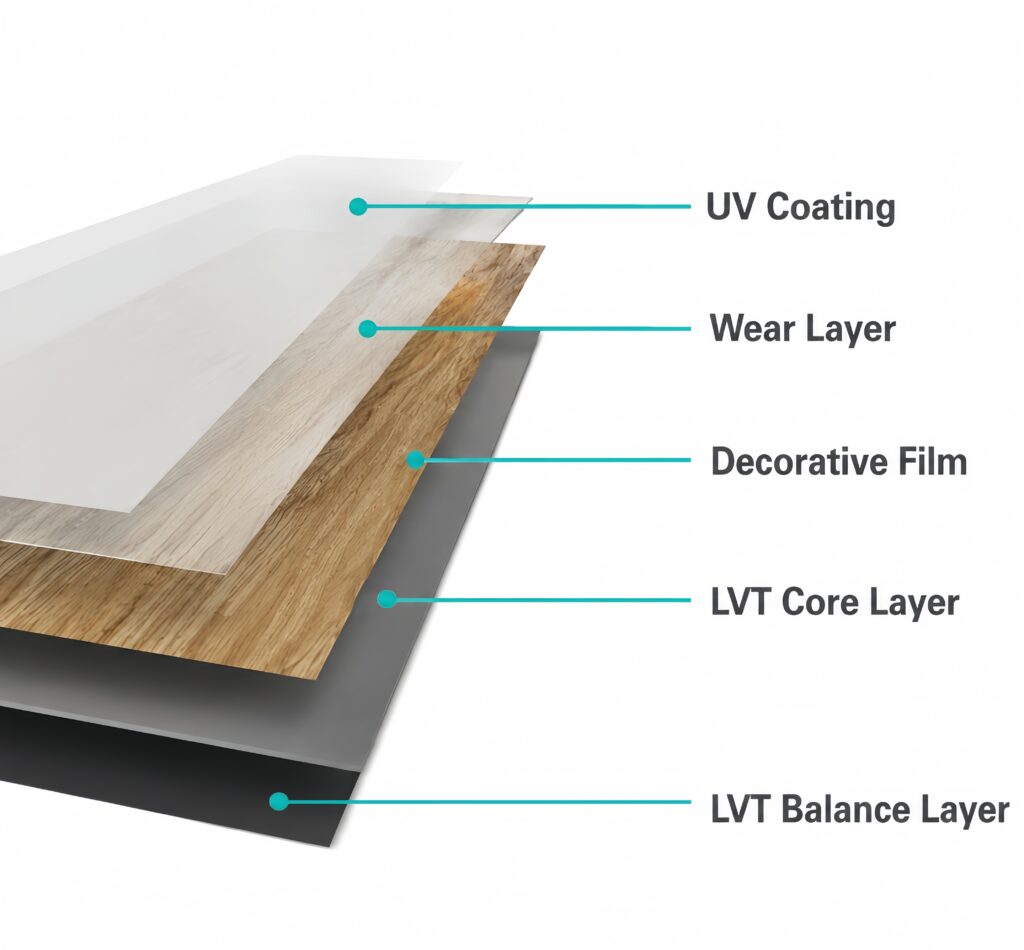
LVT = Luxury Vinyl Tile — premium vinyl flooring that looks just like real wood, stone or tile.
Multi-layered, super durable, made via calendering.
Big myth busted: LVT isn’t one single product. There are 3 totally different installation types:
1.Click: Snaps together like puzzle pieces. 6-layer build, 4–5mm thick.
2.Dry back: Glue-down installation. 5-layer structure, 2–3mm thick.
3.Loose Lay: No glue, no clicks — stays put by grippy backing. 7 layers, same thickness as Click LVT.
So what exactly is SPC flooring?
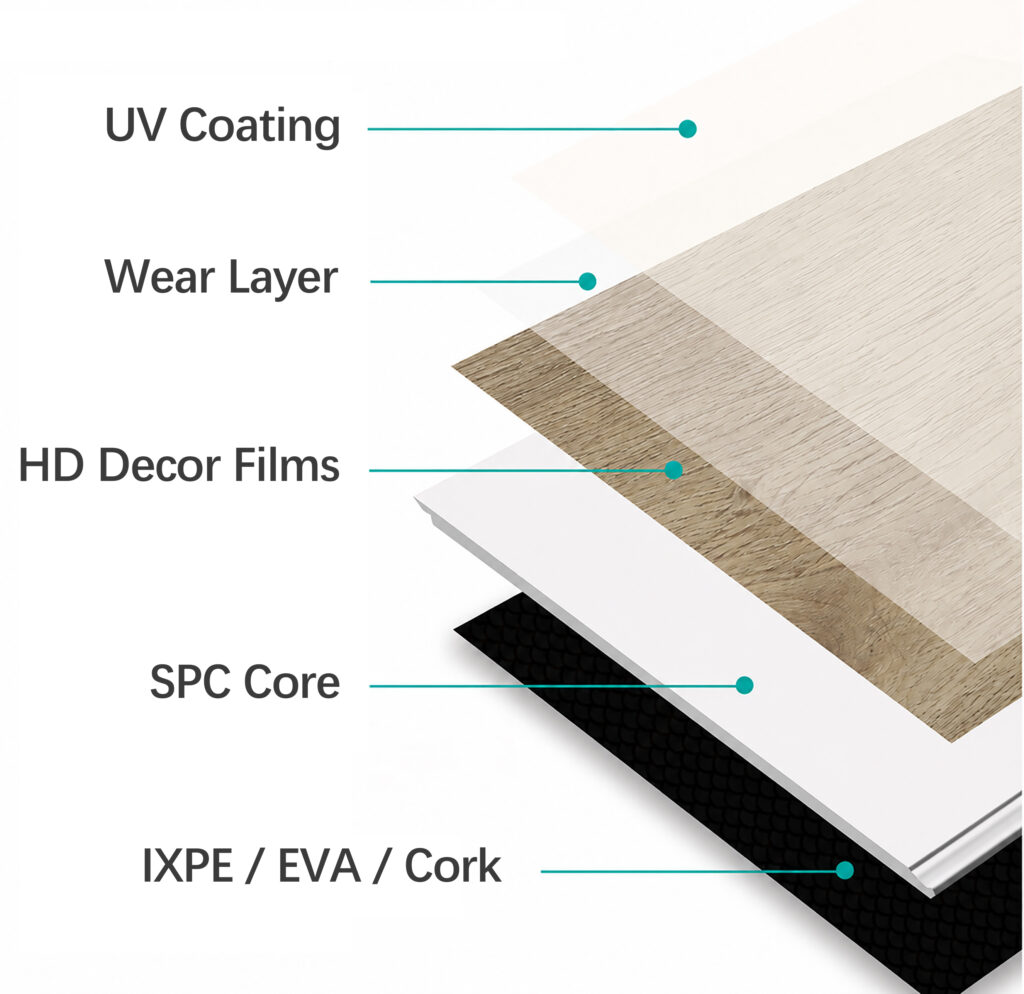
Short for Stone Plastic Composite — this is rigid-core vinyl flooring.
What makes it unique? An ultra-dense hard core made of limestone powder + virgin PVC, formed by extrusion.
Quick facts:
1.Layer build: UV coat, Wear layer, HD printed film, SPC core, Underlayment (IXPE/EVA/cork)
2.Almost all are click-lock design
3.Thickness: 3.5mm – 8mm
Simplified LVT vs SPC Comparison
| Item | LVT (Luxury Vinyl Tile) | SPC (Stone Plastic Composite) | Test Standard |
| Core Type | Flexible PVC + stone powder core | Ultra-rigid limestone + PVC hard core | EN 649 (LVT) / EN 14041 (SPC) |
| Foot Feel & Load Resistance | Slightly soft underfoot; higher indentation risk | Solid & hard underfoot; better heavy-load resistance | EN 433 |
| Common Thickness | 2 – 5 mm | 3.5 – 8 mm | EN 428 |
| Heat Dimensional Stability | Good (moderate expansion/shrinkage) | Excellent (minimal size change) | EN 434 |
| Water Resistance | Waterproof (unsealed seams may leak) | 100% waterproof (core repels water completely) | Related: EN 434* |
| Wear Resistance Grade | Residential → heavy commercial use | Heavy residential → light commercial use | EN 685 / EN 660-2 |
| Dry Slip Resistance | Standard R9–R10 | Standard R9–R10 | EN 13893 |
| Fire Reaction Rating | Typical: Cfl-s1 ~ Bfl-s1 | Typical: Bfl-s1 | EN 13501-1 |
| Installation Options | Click / Glue-down / Loose lay | Almost all click-lock (floating install) | – |
| Best Application Scenarios | Commercial spaces, cozy residential areas | Bathrooms, kitchens, high-traffic homes | – |
The core difference? Material costs.
Let’s dive into factory-level details — this is where all the pricing confusion starts.
The real price gap between LVT and SPC, broken down simply
LVT (especially dryback) = simpler production + lower raw material costs.
Industry hack: thinner floors = more sqm per container.
A 20ft container holds 5000-5500 sqm of 2mm dryback LVT — 40-50% more than 7mm SPC. Massive freight savings for big projects.
SPC uses cheaper limestone, but it’s super dense. More material per sqm = higher FOB than thin LVT.
Quick price cheat sheet:
1.Dryback LVT < SPC (cheapest option)
2.Click LVT ≈ Click SPC (similar price)
3.Same thickness? SPC is slightly cheaper
What actually impacts your flooring project budget?
It all boils down to 3 things:install speed, labor costs, and subfloor requirements.
Let’s spill an industry secret: the material price tag isn’t what blows your flooring budget — it’s the installation.
SPC click floors are a total game-changer for project timelines. With that 5G locking system, a solid crew can knock out 30–40% more square footage per day than glue-down floors. No glue, no waiting around for it to dry — you can walk on it the second the last plank is down. For hotel flips or apartment turnovers? That’s huge labor savings, plus you get the space back online way faster. It’s also way more forgiving if your subfloor isn’t perfectly flat, so you can skip expensive leveling work on older buildings.
And here’s the thing about LVT — people act like it’s all one product, but install costs vary wildly:
1.Click LVT is basically identical to SPC: same speed, same labor price
2.Glue-down dryback LVT? It’s the slowest, priciest option. You’ve got glue costs, application time, and then you have to wait for it to cure. Labor alone runs $1–3 per square foot, vs $1–2 for click floors
3.Loose lay lands right in the middle: faster than glue, but it still needs a perfectly smooth subfloor. No rigid core to cover up bumps, so bad subfloors will still hit your wallet
4.Bottom line: flexible LVT is super picky about your base floor. If it’s rough or uneven, you’re paying for self-leveling before you even lay the first tile.
After covering all these details, I believe you must be wondering: what scenarios are LVT and SPC flooring suitable for respectively?
After seeing countless designers and buyers make missteps on flooring selection, here’s my practical guidance on choosing between SPC and LVT, built on years of industry experience.
SPC is the stronger choice in these scenarios:
1.Hotel guest rooms, multi-family residences and light commercial spaces
2.Projects with mediocre subfloor conditions and no budget for extensive leveling work
3.Tight timelines requiring fast installation with no curing downtime
4.Areas prone to temperature fluctuations, such as sunlit zones, unheated premises or regions with extreme temperature differences
LVT performs best for:
1.Cost-effective multi-family housing and light commercial projects
2.Clients who prioritize a softer, more comfortable underfoot experience
To wrap up this article, let me draw a conclusion:
The optimal way to decide between SPC and LVT flooring is to match the product to your project’s actual requirements, rather than blindly purchasing whichever option is hyped up the most by marketing campaigns.
If any supplier claims “SPC is just a superior version of LVT” or tries to push 10mm-thick SPC for your project, walk away immediately. They either lack professional knowledge of their own products, or are simply trying to overcharge you.